
Cognizant Through the Value Lens: An IT Services Breakdown
Every month, we run our model across every S&P 500 stock and score them on valuation, DCF, quality, and growth. This month, CTSH scored third on the value lens. Here is why that is interesting.
Every month, we run our model across every S&P 500 stock and score them on valuation, DCF, quality, and growth. This month, CTSH scored third on the value lens. Here is why that is interesting.
The Company
Cognizant (CTSH) is a large IT services and consulting company. Think digital transformation, cloud migration, AI integration, software development and outsourcing for some of the world's biggest enterprises across healthcare, financial services, manufacturing and retail.
The stock has been drifting lower since hitting an all-time high around $90 in 2022 and has never reclaimed those levels, currently sitting at $64. The market has been unimpressed with tepid revenue growth and concerns about enterprise IT spending slowing down.
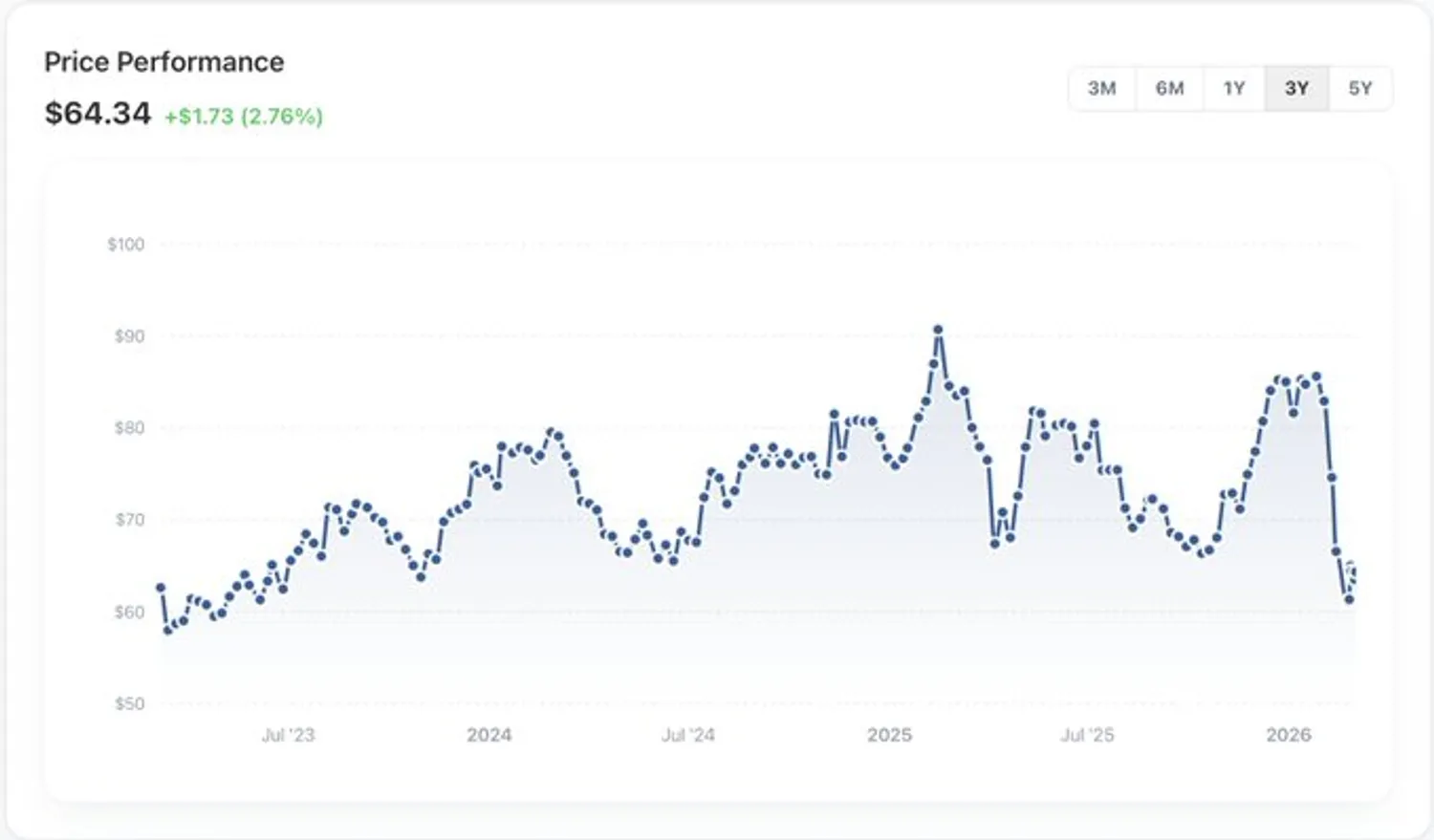 Figure 1. CTSH 3-year price performance: Peaked near $90 in early 2025, and has since pulled back sharply to $64, sitting near a 3-year low.
How the Algo Works
Our model screens the entire S&P 500 every month and scores stocks across four pillars: traditional valuation (P/E, P/B, EV/EBITDA), DCF validation, quality metrics (ROE, ROIC, current ratio, debt levels, margins), and growth (revenue CAGR and FCF trend). Quality carries the most weight at 35 points out of 100, because consistent financial health tends to be a better long-term predictor than cheap multiples alone. Sectors like financials, real estate and commodities are excluded because their valuation dynamics are structurally different. Everything gets scored within its sector context, so a tech company is measured against tech peers, not a utility.
You can build and explore your own score on the Strategies page.
The Results for CTSH
CTSH came out with a 7.7/10 this month and scored third on the value lens.
The DCF score was a perfect 20/20, implying around 59% margin of safety to fair value at the current price. That is a big number.
The traditional value score was 22/30 on a 13.9x P/E, which is well below the sector average.
Quality came in at 25/35, supported by solid ROE and ROIC numbers, a current ratio of 2.3x and an interest coverage ratio above 90x. Essentially zero debt. The full quality breakdown is on CTSH's Quality Analysis page.
Revenue CAGR is a modest 5.1%, which is what kept the growth score from being higher, but the overall profile is of a high-quality business trading at a meaningful discount.
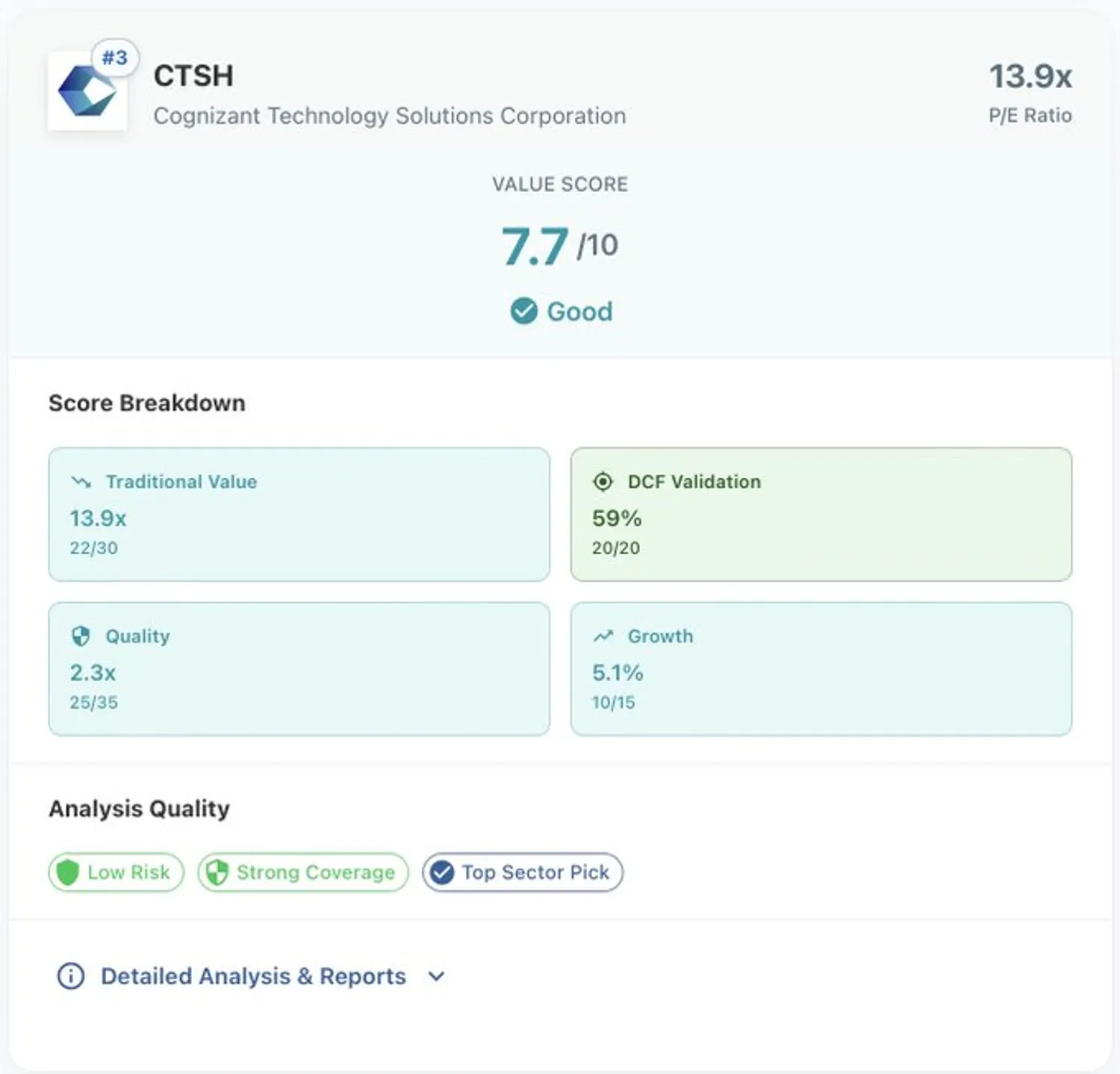 Figure 2. CTSH scores 7.7/10 on our value model for March 2026: Perfect DCF score and Low Risk badges across the board.
You can explore CTSH's full DCF breakdown on our Valuation Analysis page.
The Bear Case
We try not to be cheerleaders. The bear case for CTSH is legitimate and worth sitting with. Revenue growth is slow, and the near-term outlook is not obviously better. There is also a structural question hanging over the entire IT services sector. If AI continues to improve at its current pace, the economics of large offshore development teams start to look different. Cognizant has been investing heavily in AI capabilities and has rebranded a lot of its service lines accordingly, but investors are right to ask whether the transition is fast enough and deep enough. Finally, the DCF is only as good as its assumptions. A 59% margin of safety sounds compelling, but if the growth rate over the next decade comes in meaningfully below what the model assumes, that gap narrows quickly.
The Bottom Line
CTSH is a 7.7/10 on our model because it is a high-quality business with essentially no debt, strong cash generation, and a valuation that reflects a lot of bad news already. The DCF gap is wide enough to provide a genuine cushion even if the recovery takes longer than expected. It is not flashy, but value investing rarely is.
The stock scored third on the value lens in the S&P 500 this month. We think the market is discounting Cognizant's quality too heavily relative to its near-term growth struggles. That may take time to correct, but the balance sheet gives it the runway to wait.
This article was originally published on X on 4 March 2026. We have retained the original publication date on this platform for consistency. All data, prices, and results reflect information available at the time of publication.
This analysis is for educational purposes only and does not constitute financial advice. Our algorithm scores stocks based on quantitative value metrics only and does not account for macroeconomic conditions, your personal risk tolerance, or individual financial circumstances. Do your own research before making any investment decisions.