
Why Tech Stocks Lost $1 Trillion Despite Beating Earnings
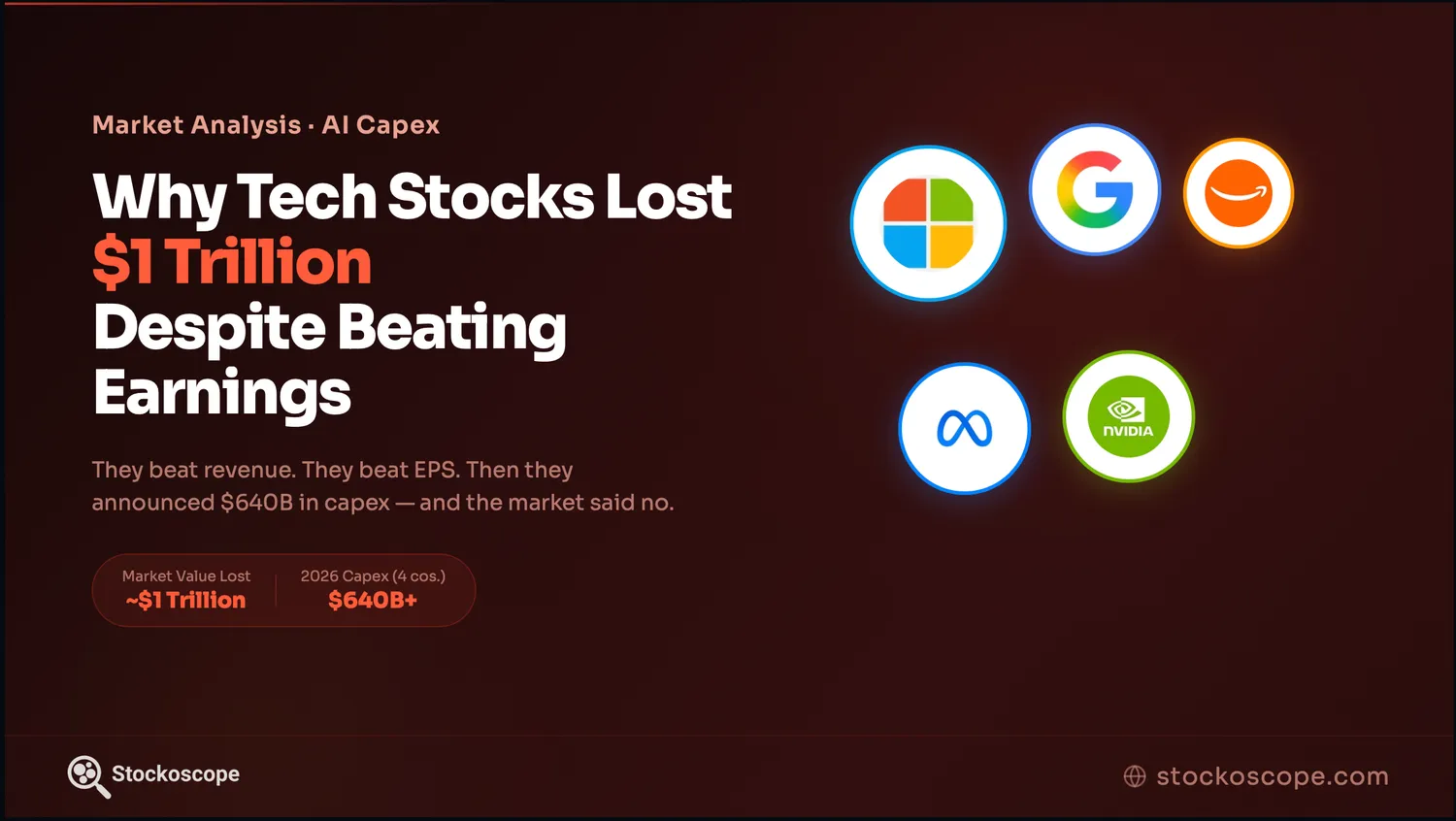
Technology stocks experienced their worst selloff since April 2025. Software stocks alone lost approximately $1 trillion in market value. The companies beat earnings. So what happened?
Two months ago, we wrote about Michael Burry's controversial short position Michael Burry's controversial short position in Nvidia (NVDA), explaining his thesis that hyperscalers were systematically overstating earnings by depreciating GPU purchases over 5 to 6 years when the real economic life was closer to 2 or 3 years. The market laughed. NVDA bulls called him a has-been. AI enthusiasts dismissed the concerns as the ramblings of someone who didn't understand the transformative power of artificial intelligence.
This week, the market stopped laughing.
The Week Everything Changed
This week, technology stocks experienced their worst selloff since April 2025. Software stocks alone lost approximately $1 trillion in market value. Microsoft (MSFT) dropped about 5%, extending weekly losses to over 10%. And Amazon (AMZN) plunged 11% in a single day, including premarket, despite posting its fastest AWS growth in 13 quarters.
But here's what makes this week remarkable: these companies actually beat their earnings estimates. Alphabet's (GOOGL) revenue grew 18% year-over-year. Amazon's cloud services exceeded expectations. Microsoft's Azure business remained strong. Google Cloud posted 48% growth. By any traditional measure, these were solid quarters that should have sent stocks higher. Instead, the market destroyed them. And the reason wasn't earnings, wasn't revenue, wasn't even growth rates. It was capital expenditures.
The Capex Bomb
During earnings calls this week, the major hyperscalers revealed spending plans that shocked even the most bullish analysts. The numbers were staggering, and more importantly, they were accelerating far beyond what Wall Street had anticipated.
Table 1. Hyperscaler capital expenditure commitments for 2026 versus 2025 actuals. Microsoft full-year figure estimated from quarterly run rate. Sources: Company earnings calls, February 2026.
| Company | 2025 Capex | 2026 Capex Guidance | YoY Change |
|---|---|---|---|
| Alphabet (GOOGL) | $91.4B | $175B–$185B | ~100% |
| Amazon (AMZN) | $131.8B | ~$200B | ~52% |
| Meta Platforms (META) | $72B | $115B–$135B | ~80% |
| Microsoft (MSFT) | ~$80B | ~$150B (est.) | ~88% |
| Total | ~$375B | ~$640B+ | ~70% |
Alphabet's CFO announced that the company expects to spend between $175 billion and $185 billion on capital expenditures in 2026, which is more than double the $91.4 billion spent in 2025.
Amazon revealed plans to spend roughly $200 billion on capital expenditures in 2026, up from $131.8 billion in 2025. The shock was even more pronounced because analysts had only been expecting $146.6 billion.
Meta Platforms had already set the stage the week prior, projecting capital expenditures between $115 billion and $135 billion for 2026, nearly double the $72 billion spent in 2025.
And Microsoft, though it did not provide a full-year figure, made it clear that capex growth would accelerate in fiscal 2026 based on the run rate from its most recent quarter, putting it on track for approximately $150 billion.
When you add it all up, these four companies alone are committing to spend over $640 billion in a single year. To put that in perspective, it's more than Sweden's entire GDP. And this isn't a one-time investment: it's an annual commitment that needs to be sustained, and potentially grown, year after year after year.
This Is Exactly What Burry Warned About
In our original analysis published in December 2025, we explained Burry's core thesis in detail. Hyperscalers, he argued, were depreciating their GPU purchases over 5 to 6 years, treating them as long-lived assets similar to traditional data center equipment. But the technology was advancing so rapidly that these chips became economically obsolete long before they physically failed.
Burry's argument wasn't that the chips die after 3 years. It was that they became economically unviable to operate. When newer generations offer 2–30x better performance per watt, the old chips don't break - they just become too expensive to run competitively.
He argued that this created a systematic overstatement of earnings. If companies depreciate hardware over 6 years but actually need to replace it every 3 years to remain competitive, they're underreporting the true cost of their infrastructure buildout. And more importantly, they're setting themselves up for a cash flow crisis when the replacement cycle catches up with them.
The Evidence Is Materialising Right Now
What makes this week so remarkable is that Burry's thesis is no longer speculative. The evidence is showing up in real time in the companies' financial statements and earnings calls. Depreciation from earlier GPU purchases is hitting income statements, eating into margins, and this is only going to accelerate as spending from 2023 and 2024 works its way through the depreciation schedules.
Elevated capital expenditures are currently the primary drag on these companies' valuations. As capex-to-revenue ratios rise sharply into the high 20s or low 30s, free cash flow conversion weakens in the near term, even with solid revenue growth and operating margins, because so much cash is being reinvested rather than returned to shareholders. If the economic life of GPU hardware remains shorter than the depreciation periods (2–3 years vs. 5–6 years), this creates a structural headwind: ongoing replacement needs keep capex permanently elevated, reducing FCF yields and compressing valuation multiples compared to historical levels. Investors are increasingly pricing in this risk, demanding clearer evidence that the spending won't erode shareholder value over time.
However, the offsetting factor is the potential return on invested capital from these massive AI buildouts. If hyperscalers can successfully monetise the infrastructure, the incremental returns could eventually outpace the capex burden and drive stronger free cash flow growth. Executives continue to express high confidence in this outcome, citing robust demand, early AI monetisation wins, and the transformative potential of the technology.
The valuation outcome therefore hinges on the timing and scale of ROI: faster, stronger returns could ease the pressure and support higher multiples, while delayed or insufficient ROI would reinforce the capex headwind and keep valuations constrained, aligning with the core concerns in Burry's thesis.
Note: While the staggering capex guidance from hyperscalers was a clear catalyst for the sharp drops in their shares, the broader ~$1 trillion wipeout in software and services stocks stems from multiple converging pressures. Chief among them are mounting fears that advancing AI tools could disrupt traditional SaaS models by automating workflows that previously required software subscriptions.
Where Do We Go From Here
The market gave hyperscalers the benefit of the doubt for two years, accepting that massive AI infrastructure investments would eventually pay off through new revenue streams and efficiency gains. This week, that benefit of the doubt expired. Investors are now demanding proof that returns will justify investment, and they're not willing to wait patiently while capex continues to escalate.
The questions investors are asking now are the same ones we posed in our original Burry analysis: Can tech companies sustain billions in capital expenditures per year indefinitely, when the infrastructure they're building may need to be replaced every 3 years rather than every 6?
Two months ago, when we first published this analysis, the market's answer was an emphatic "yes." Investors believed that AI would generate returns that would justify this spending, that chips would retain economic value for their full depreciation period, and that demand would remain robust enough to support continued growth in capex.
This week, after losing $1 trillion in market value and watching tech stocks crash on strong earnings, the market is starting to say "maybe not."
The market is finally demanding proof, not promises. It's starting to shout: Show us the returns, or the music stops.
Related Reading: Understanding Michael Burry's Nvidia Short, how we model AI capex in a DCF, and what the hyperscalers' prices already assume about the AI return
This article was originally published on X on 6 February 2026. We have retained the original publication date on this platform for consistency. All data, prices, and results reflect information available at the time of publication.
This analysis is for educational purposes only and should not be considered investment advice. The author may hold positions in the stocks mentioned. Always do your own research and consult with a financial advisor before making investment decisions.